Year 3
Autumn 1 2026
Welcome to Year 3!
Our class is taught by Miss Nicholls on Monday and Tuesday each week, with the rest of the week being taught by Mrs Jones.
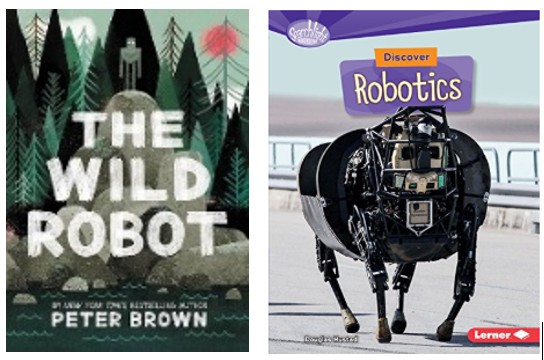
This half-term our topic focus is robots! We will be reading ‘The Wild Robot’ by Peter Brown and our non-fiction book will be ‘Discover Robotics’ by Douglas Hustad.
Y3 Lanner Matrix 1 overview_26-27
English
We will be studying our core text, ‘The Wild Robot’ throughout the half-term. Linked to this, we will be learning about poetry with rhyming couplets, writing explanation texts about how some robots work and creating narratives based on the story of ‘The Wild Robot’, with a particular focus on exploring the main character.
Maths
As mathematicians, we will start the term learning about place value, focusing on representing, partitioning, comparing and ordering numbers up to 1000. We will then build on our knowledge of place value through our addition and subtraction topic where we will add and subtract across 100, building to written methods to add and subtract to and from 3-digit numbers.
Science
This term we will be learning about forces, including contact and non-contact forces. We will then focus on learning about magnets and how they work, including investigating if we can move small objects with magnetism, and the different strength of magnets.
Please see below for the Y3 Autumn 1 Science Knowledge and Vocabulary mat.
Geography
In Geography this half-term we will learn about the features of our local area, how it has changed over time and how it compares with larger cities within the UK. We will learn about larger cities such as London in England, Cardiff in Wales, Edinburgh in Scotland and Belfast in Northern Ireland.
Please see below for the Y3 Geography Knowledge and Vocabulary mat.
DT
This half-term, we will research pneumatic objects and use our learning to design, create and evaluate our own pneumatic ‘Moving Monsters’.
PE
Our PE days will be on Tuesdays and Thursdays. Please wear your PE kit, including your school PE hoody on those days. When the weather gets colder, leggings or jogging trousers may be worn. Please remember that long hair needs to be tied up and any jewellery or watches must be removed for PE.
In PE this half-term we will be doing Netball ball skills and Gymnastics.
RE
We will be focusing on Christianity in RE this half-term, starting with ‘The Big Story of the Bible’. We will then focus on the Christian story of Creation and what Christians can learn about God from this part of the Bible. We will also explore why the Bible is important to Christians.
Please see below for the Y3 RE Knowledge and Vocabulary mat.
Computing and Online Safety
In our computing lessons this half-term, we will learn about computers and how they are connected within networks, such as our school network and how computers can help us. We will also explore the parts that make up a digital device.
As part of our online safety, we will use the Project Evolve resource to learn about Self Image and Identity along with Online Relationships.
PSHE
In PSHE, we will continue to learn about different issues through a range of bools. We will learn about relationships within families – different types of family, what makes a family and features of family life.
We will also focus on respect – the importance of self-respect; behaving respectfully towards others and how to behave respectfully in different situations.
Music
We will continue our learning with Charanga music this half-term, working on the ‘Let Your Spirit Fly’ unit.
MFL
Year 3 will continue with their French lessons this term using the ‘Language Angels’ scheme. This half-term, our focus is on learning some core French phonemes and some words they feature in.
HOME LEARNING
In year 3, children need to read as much as possible. All children are expected to read at home most nights for 10 – 15 minutes either to themselves or with an adult. This could be their school reading book, listening to a story read by someone else or sharing a favourite book. All are equally valuable. All children have a reading record book in which parents, carers or the children themselves can record what they have read or make any comments.
If you’d like some ideas about books for Y3 children, please click on the link below.
Checklist-50-Best-Books-2026-27-Year-3
In addition, children all have access to Times Tables Rockstars, an online site for practising their times tables.